
Climbing with a HeartRate Monitor
Rest is the hidden limiter in bouldering. This post covers how overlong sessions led to fatigue and injuries, why I started using heart rate as an in-session recovery signal, and how a simple “base heart rate” rule helps keep attempts high quality and remove guesswork.
Juan A. Lopez Cavallotti
Progression AI Founder
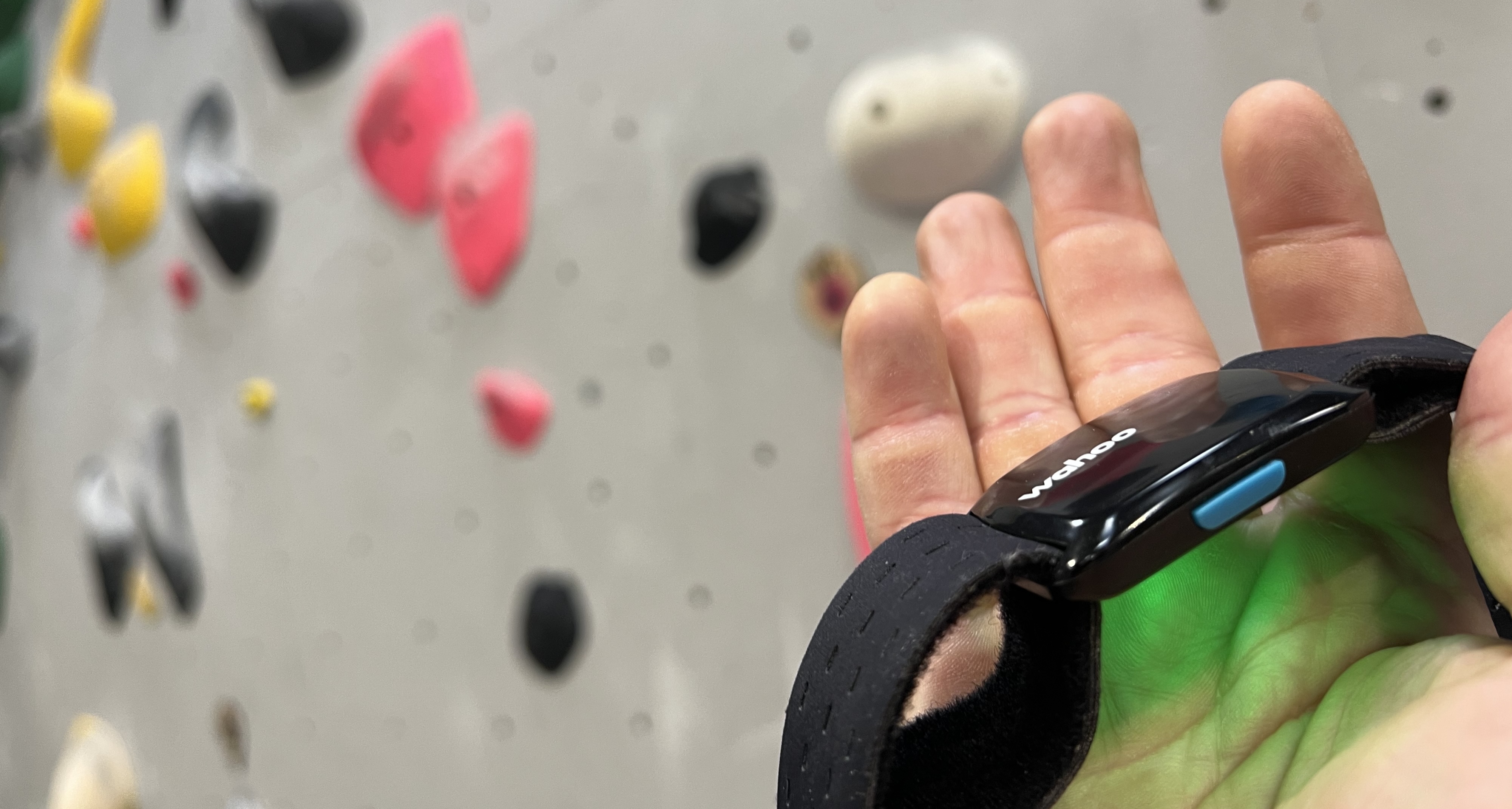
One of the biggest performance multipliers in bouldering is resting enough to keep attempts high quality.
I learned this the hard way in my first year of climbing: I did too much, too often, and accumulated fatigue without noticing.
The result was a steady stream of small injuries:
- Finger tweaks that would show up after a big session and linger for days
- Shoulder flare-ups from pulling hard and trying to “muscle through” moves when I was already tired
At the time it didn’t feel like “overtraining.” It felt like consistency.
Looking back, the real miss was treating “more time on the wall” as the goal, instead of rest between attempts and ending the session while I can still execute.
The beginner trap: 3–4 hour sessions and diminishing returns
I used to boulder for 3–4 hours at a time.
At first it felt productive: lots of attempts, lots of effort, lots of “work.”
But the pattern was always the same:
- The first chunk of the session was great.
- Then I’d start missing moves I should be able to do.
- I’d compensate by trying even harder.
- Eventually I’d end up completely cooked, grinding attempts, and pushing well past the point where the session was building anything.
In hindsight, the problem was not motivation. It was quality control.
When fatigue climbs, you don’t just lose power. You lose precision, coordination, and decision making. You start rehearsing bad movement. You make risky choices. You turn what could have been 10–20 high-signal attempts into an hour of noisy “junk volume.”
Rest is not passive. It’s part of the training
The first proof for me was subjective, but extremely consistent.
When I actually rested long enough, I moved better.
And when I didn’t, I could feel the drop-off within a few attempts:
- Hard moves that felt available early in the session suddenly felt impossible.
- Footwork and timing got sloppier.
- I started “trying harder” to compensate, which usually meant worse positions and more strain.
So rest started to look less like a break, and more like the thing that protects the quality of the whole session.
Research also tells us that recovery matters in climbing and bouldering:
- In elite bouldering, climbers manage their attempts and rest strategically, and work-to-rest patterns change with the demands of the problem.[1]
- After a national-level bouldering competition, different recovery markers return to baseline on different timelines, and perceived readiness can take longer to come back.[2]
- A systematic review on overuse injuries in adult climbers summarizes risk factors and prevention strategies, reinforcing the idea that managing load and recovery is central to staying healthy.[3]
If you are resting 30 seconds because you “feel okay,” you are usually just guaranteeing that every next attempt is slightly worse than the last.
A better question is:
Am I recovered enough that my next attempt will look like my best attempt today?
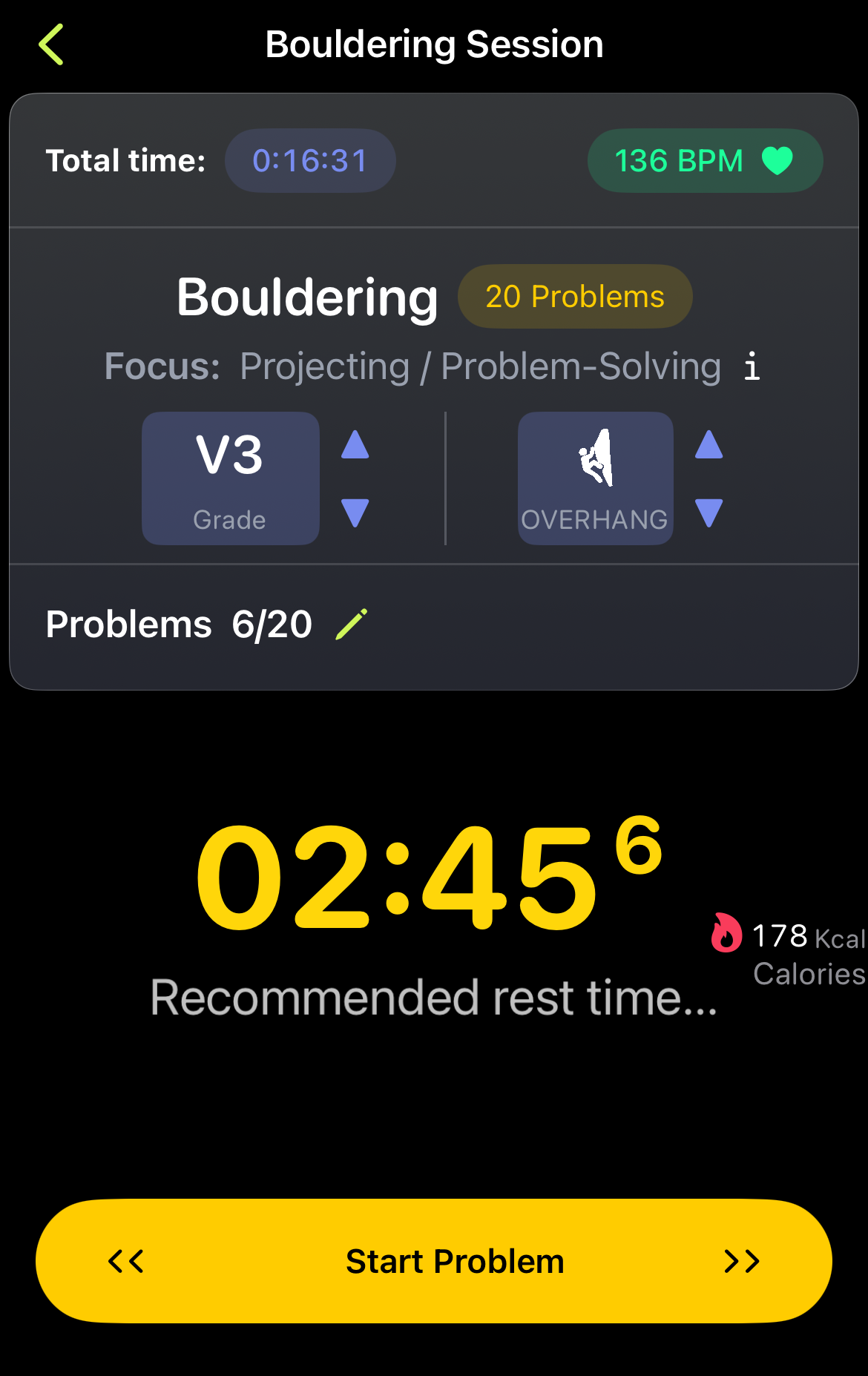
Building Progression AI: why I added heart rate monitoring
When I started building Progression AI, I wanted to make recovery less of a vague feeling and more of something I could observe.
That is one of the reasons I decided to include heart rate monitoring.
One important nuance: unlike cycling, I have not yet found a reliable way to look at heart rate after the fact and extract something that clearly unlocks progression.
In cycling, post-ride analysis (intervals, heart rate drift, time in zones) can be directly actionable.
In climbing, at least for me so far, the value of heart rate has been much more in-the-moment. It’s proven to be a great tool during sessions because it helps me:
- Notice when I am not recovering between efforts
- Make rest decisions with less ego and more data
- Stop before I cross the line into grinding
This is true even without fancy tooling. But the whole point of Progression is to remove the guesswork.
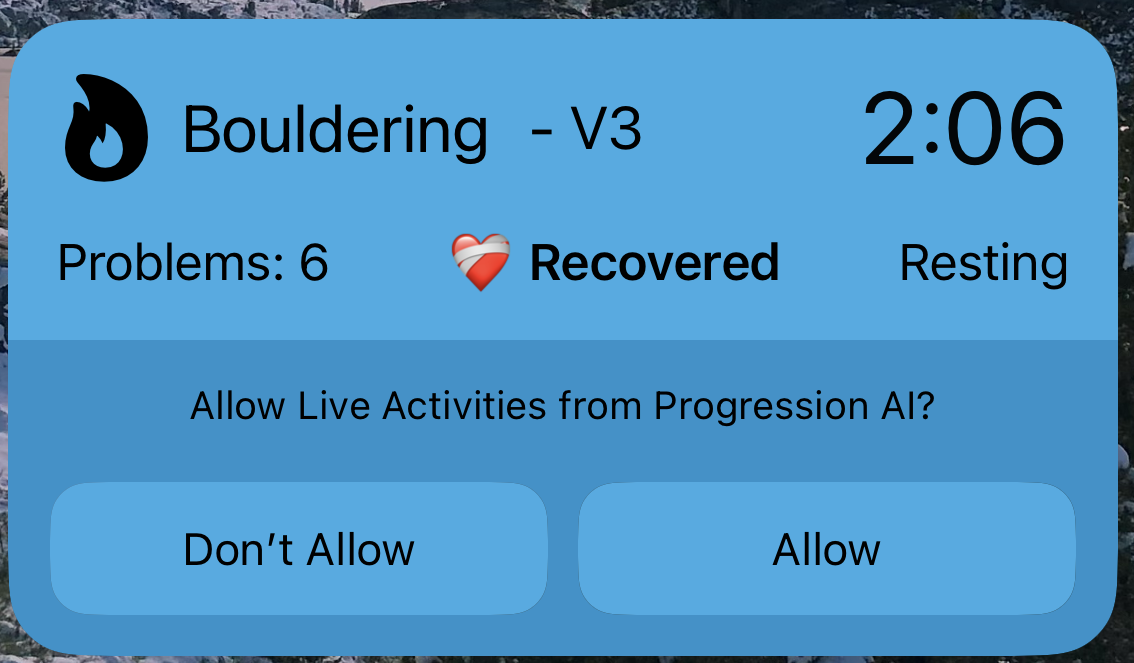
Progression’s app tells me when my heart rate has actually returned to a baseline, so “rest enough” becomes a clear signal instead of a vague feeling.
And even outside of bouldering sessions, I’ve started applying the same idea in route climbing too. Whenever I stop to shake out and rest, I try to glance at my heart rate and treat it as a quick check on whether I am actually calming down or just pretending I’m recovered.
The original idea was simple:
- Use heart rate as a window into how hard a session is really hitting me.
- Use it to notice when I am not recovering between attempts.
- Use it to catch the moment when the session starts shifting from high quality work to grinding.
The signal I did not expect: min and max heart rate creeping up
Once I started paying attention during fatigued sessions, I noticed something surprising.
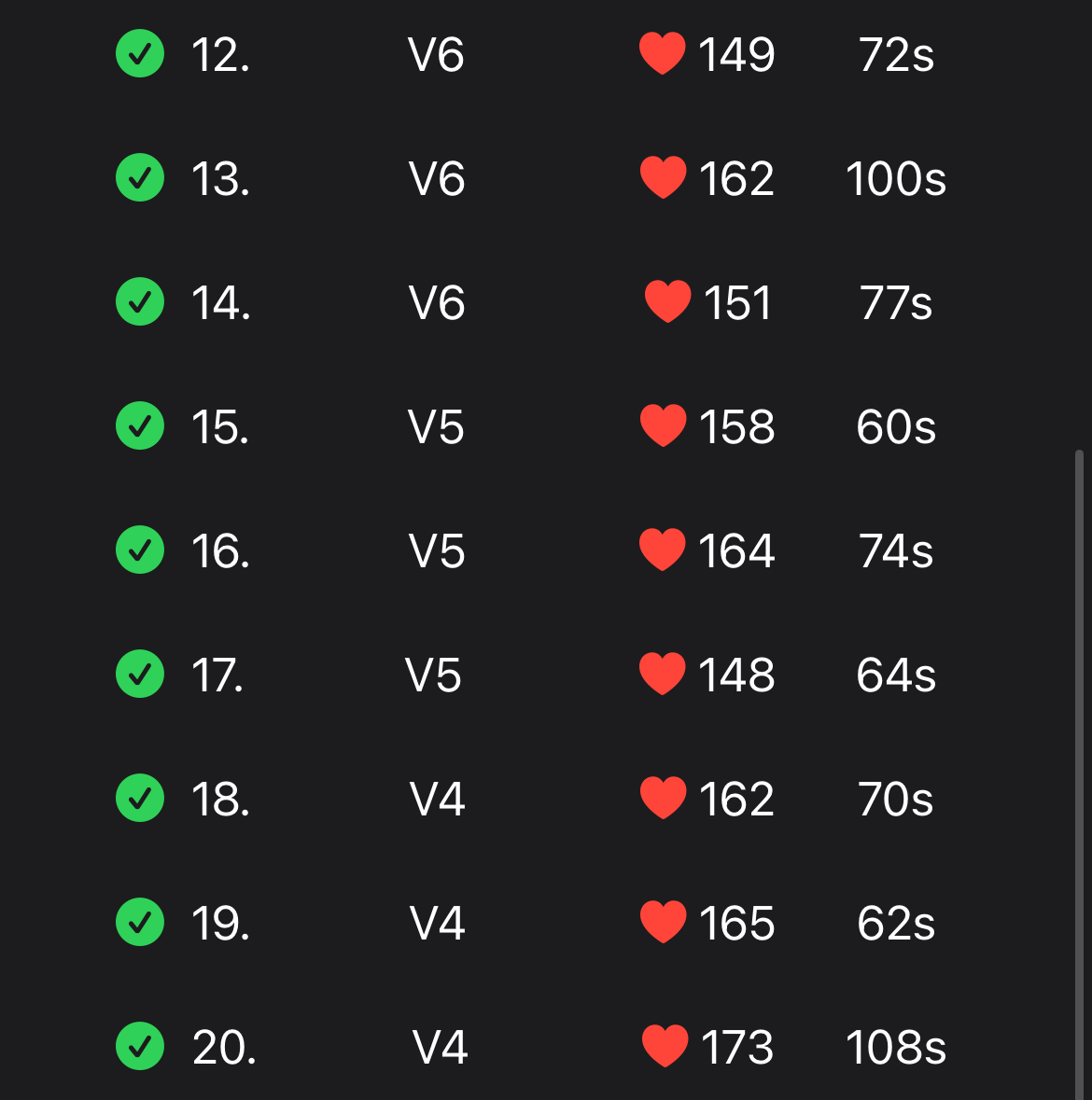
As I got more tired, both my minimum and maximum heart rate tended to increase with each attempt.
- My minimum heart rate between attempts stayed higher.
- My maximum heart rate during efforts pushed higher.
That creeping baseline was a clear sign that I was not returning to a stable, recovered state. Even if I felt like I was “ready enough,” my body was still carrying stress from the previous attempts.
What I do differently now
The big shift has been treating sessions like a limited budget of quality.
What cycling taught me about bouldering: intervals and recovery
This mindset clicked for me because I come from cycling.
In cycling, I learned pretty quickly that fitness doesn’t come from riding “kind of hard” for as long as possible. It comes from structured intervals: short periods of very high effort, followed by real recovery, repeated enough times to create a training signal.
Bouldering is obviously not the same sport, but the pattern is surprisingly similar:
- A hard boulder attempt is an interval.
- Rest between attempts is the recovery.
- A session is the set.
If you remove the recovery, what you end up doing is not “more intervals.” You just turn everything into a lower-quality, half-recovered effort where you are too tired to produce peak output.
That was exactly what my 3–4 hour sessions felt like.
Once I started treating bouldering like interval work, the goal shifted from doing more attempts to doing better attempts, with enough rest to keep intensity where it belongs.
The clearest change is that I now stop the session the moment I notice my heart is struggling.
Not because a higher heart rate is “bad,” but because it usually correlates with exactly what I’m trying to avoid: attempts that are no longer crisp, longer recovery between goes, and a slide into grinding.
My “base heart rate” rule
To make the decision easier, I gave myself a simple rule of thumb: a base heart rate that tells me whether I have rested enough for the next high-quality attempt.
Practically:
- I rest at least 4 minutes after a hard attempt.
- Then I check whether my heart rate is back near my “base” for that session.
- If I’m still noticeably above it, I keep resting instead of forcing the next go.
It’s a simple time floor plus a recovery check. The point is avoiding the pattern where I feel ready, go too early, and slowly dig a deeper hole.
A few other practical changes that helped:
- Rest longer than you think. Two to five minutes between hard attempts is common, especially on steep or power moves.
- Cap the session when quality drops. If coordination and power are clearly sliding, it is usually better to leave a little in the tank.
- Watch trends, not single numbers. Heart rate is noisy, but a consistent upward drift in “between-attempt” heart rate is information.
Takeaway
More effort is not always more progress.
If you want to get better at bouldering, your goal is not to survive a 4 hour session. Your goal is to stack high quality attempts, recover enough to execute them, and stop before you are training the wrong thing.
If you are curious, this is exactly the kind of pattern I want Progression AI to help surface: when your session is productive, and when it is time to back off so that you can come back stronger.
Keywords
Juan A. Lopez Cavallotti
Progression AI Founder
I am a rock climber and a software engineer. I am very passionate about training and love all kinds of sports and the outdoors.
Follow on Instagram (@juan.climbs)